A Flash-back Of The Serengeti
The Maasai word "Siringet" meaning "endless plains", is at the origin of the name of this National Park, and sums up the emotion felt by the visitor when contemplating Africa at its wildest. This area, which covers approximately 14,800 square kilometres was partly protected in the 1920's, then became a reserve in 1950 and certain species were totaly protected. In 1951 the Serengeti became a National Park, and included the highland plateau of Ngorongoro, which became separate in 1959.
Is Serengeti worth to visit?
After the Selous Game Reserve (currently a Nyerere National Park) to the south east, it is the largest reserve in Tanzania, and is continuous with the smaller Maasai Mara to the north in Kenya. The Serengeti National Park stretches from the highland plateau of the Ngorongoro in the south to the mountainous slopes of Isuria in the north. It reaches as far as Lake Victoria to the west in the form of a wide corridor. The altitude varies between 920 and 1850 metres above sea level, the Seronera camp site being at 1530 metres.
The originality of this park is in its great variety of environments: wide grass plains to the south, acacia savannah in the central region, more densely wooded hills to the north, and in the western corridor a vast woodland area with mountains overlooking the plains. The diversity of the scenery, now plains with rivers and lakes, now hills and outcrops of rock (the famous kopjes so characteristic of the Serengeti), gives a feeling of infinite variety and incomparable wildness, an impression of the sumptuousness and permanent renewal, and in the amazing early morning or evening light certain landscapes are stunningly beautiful.
Grass and Herbivores
The grassland has become well-adapted to sereve dry seasons, annual bushfires, and the constant trampling and grazing of the multitudes of herbivores. The grasses have exceptional nutritional qualities which are necessary for the survival of these animals, and provide food for vast herds, concentrations of which are unequalled the world over. As well as their number and density, the inhabitants of the savannah are also extremely diversified. Certain types of animal behaviour are unique to this region, including the phenomenon of migration.
The Incredible Migration
The migration of the wildebeest is unquestionably the phenomenon which has most contributed to the reputation of Serengeti and its ecosystem. Every year colossal numbers of animals gather on the plains, particularly wildebeest, gazelles and zebras. It is a breathtaking sight. This is the only spot in the world where such an exceptional event takes place, year after year, undisturbed by man for centuries.
As in all ecosystems, vegetation and animal life are closely linked, and for this reason, no giraffes live on these treeless plains, where they cannot find the leaves and thorns on which they feed. In the park, the main characteristics of the vegetation eaten by wildebeest and which prompts them to undertake their great trek in such huge numbers, is the length and quality of the grass on which they graze. As the pastures become progressively less green and begin to wither, the wildebeest travel from the south east towards the north west, in the direction of Lake Victoria. Thus they migrate towards the wetter areas, and at the end of the dry season, arrive in Kenya, in the Maasai Mara National park.

The wildbeest migrate over long distances. systematically covering broad expanses of land, and for this reason the vast savannah is never totally exhausted. The remarkable phenomemon of the migration of the great herbivores of the Serengeti ecosystem: Professor Bernard Grzimek and his son. They made systematic studies of the seasonal movements of the herds, migrations which owe their existence to the never-ending search for fresh pastures, and the green grass which grows after the rains begin again. This mass movement, which starts at the beginning of the dry season (usually in May-June) resembles a gigantic army of animals leaving the highland plateau, where they will once again return five months later to gather in the wettest areas of the park.
Long columns of wildebeest, sometimes as long as 40 kilometres, have been observed from the air, moving in a south westerly direction. During the rainy season, from November to May, the plains t the south east of the park are covered with short grass, and provide a source of food for millions of animals, among which can be found about 1.3 million wildebeest, 250,000 gazelles and 200,000 Burchell's zebras.
The plains are extremely fertile during the rainy season, but as there is no permanent source of water, the only means of subsistence for the animals are the natural hollows, which hold the water trickling down from the slopes. The wildebeest and zebras are dependant on the water which they must drink regularly. The wildebeest is the chief herbivores of the Serengeti because it has adjusted to the environment, and is able to survive better than the other herbivores. However, the huge concentrations of grazing wildebeest quickly use up the available grass, and must necessarily move away in search of food. This explains the great migration - a continual search for water and fresh pastures, which compels the wildebeest to undertake a circuit of over 80 kilometres, and actually much farther because of the twisting route which the animals take. This long trek generally begins as soon as all the green grass has disappeared. The wildebeest, after their long and dangerous migration from North to South, breed in the Serengeti plains. Here,in these green pastures, they will remain for a few weeks beofore starting off on their trek towards Kenya in February. The wild dog is one of the wildebeest's main predators.

The Perpetuation of the Species
The reproductive period of the wildebeest coincides precisely with the migratory period. In less than three weeks, 90% of the femalesmate, a total of about 400,000 animals. At this time, the bulls begin to establish territories, become more agressive and try to mate with as many females as possible. Eight and a half months later, the females give birth to their calves in the short grass plains. The birth of dozens of wildebeest calves in the middle of this bare landscape is an incredible sight. In less than ten minutes the calf can get to its feet and kee up with its mother. The newly-born calves are preyed upon by lions or hyenas, while the older ones are attacked by leopards or wild dogs. Within two days of its birth the calf can run so fast that even the hyenas, its main predator, abondons the chase. The synchronised calving of the wildebeest effectively limits the number of calves that can be taken by predatorsin one season.
Kopjes: a unique geological phenomenon
Visitors to Serengeti National Park can witness an incredible geological feature known as kopjes. These are ancient crystalline rocks that break through the surface soil, revealing granite outcrops that rise several meters high. As softer rocks erode, jagged granite peaks appear, shaped and fragmented by harsh winds and temperature fluctuations. These formations, known as kopjes, offer sun-warmed rocks that lions favor for lounging. They provide shade and a strategic vantage point, allowing lions to escape the intense African sun and keep watch over their surroundings.
From Termites To Cheetahs
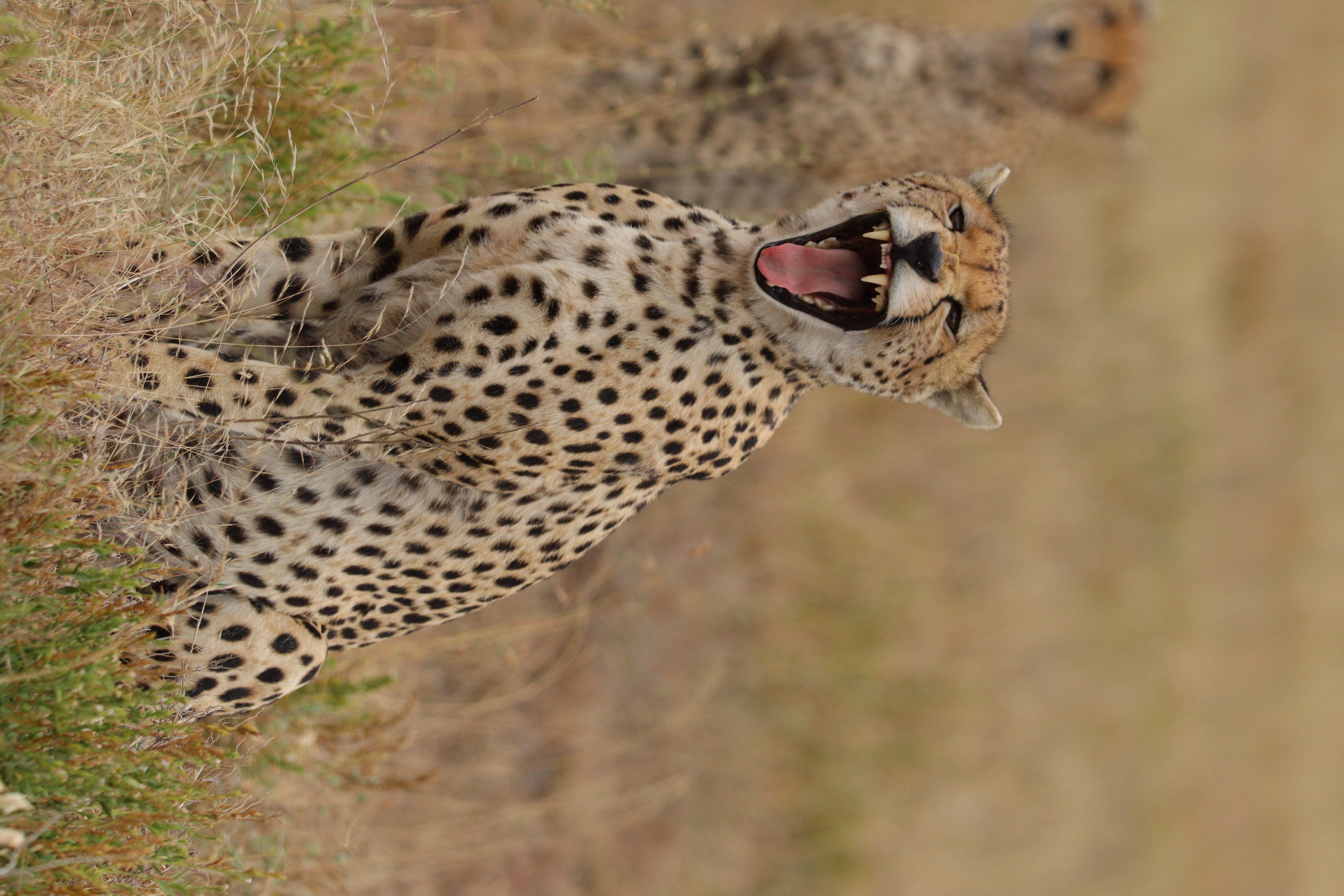
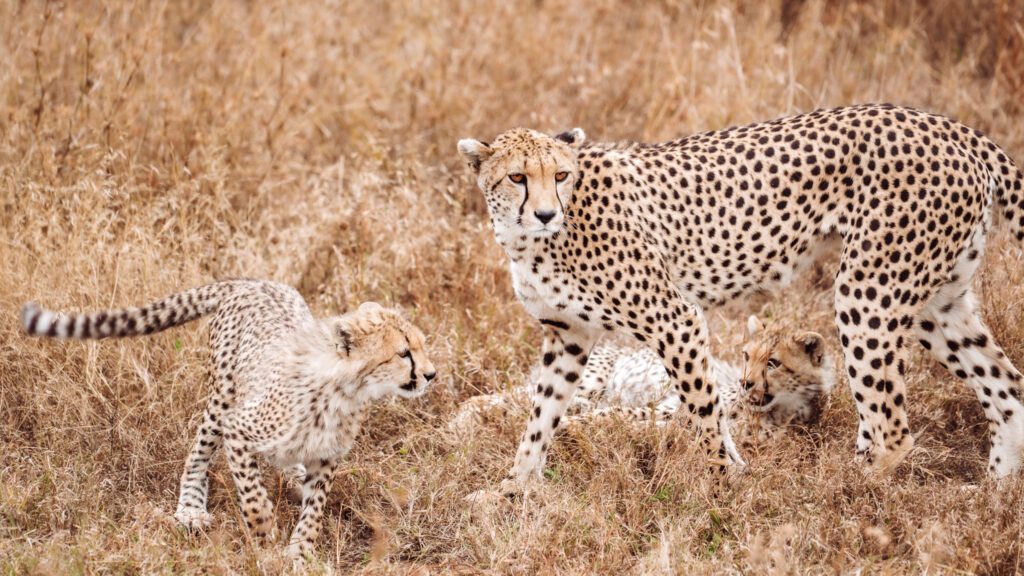
Towards the west, the short grass plains gradually give way to pastures with grass as high as 30 centimetres ner Seronera. In this section of the park enormous termite mounds can be seen, as well as herds of topis and kongonis which graze on the long grass. Thomson's and Grant's gazelles also usually seen near here, and provide choice prey for wild dogs and cheetahs. During the dry season, resident lions often prey on these species. How-ever, the main predators of the gazelles are hyenas and leopards, while jackals tend to attack the young gazelles. On the whole, the various types of habitat corespond t different forms of wildlife: in the woodlands, elephants can be found, then buffalos and zebras. Pasture land is home to the wildebeest, followed by Thompson's gazelles.The gazelles can survive for long periods without drinking, and are thus more widely scattered over the whole of the park.

Fun Fact Of The Lions Of The Serengeti:
When lions are not sleeping, they are hunting, and when not hunting they sleep, but...on the alert!